Play Wizard Community College online
A hilarious 20 minute roleplaying card game of magic and mistakes"
3–8 players, about 20 minutes, by David Marron
Buy Wizard Community College at moonsagaws.com.
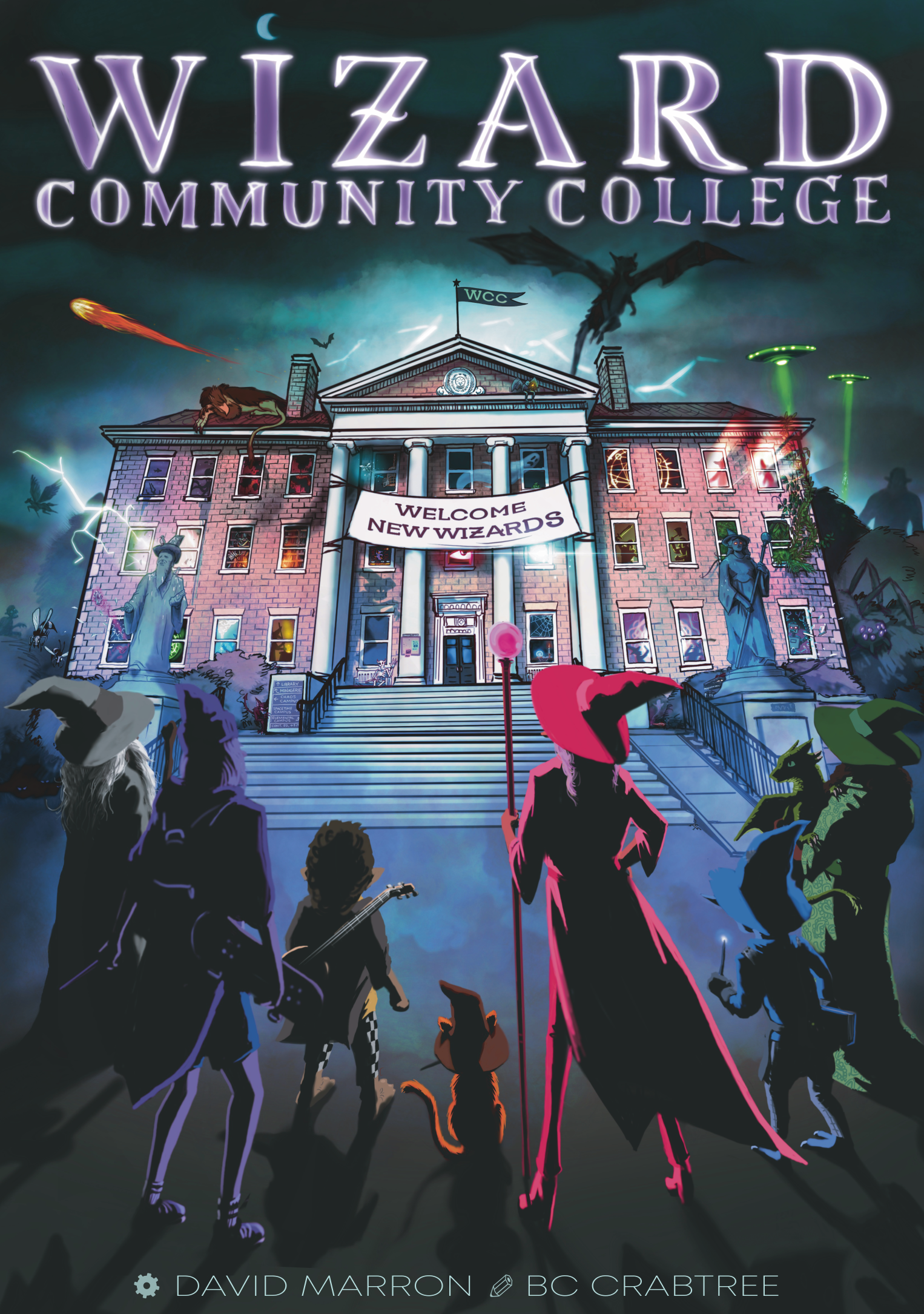
Play Wizard Community College now: free, in your browser, nothing to download. Play every seat yourself, open a table for friends and send them the link, or sit down at an open table with anyone.
How to play Wizard Community College
WCC Rules Final 10 22 25
WELCOME FUTURE WIZARDS! You’re about to embark on an exciting and, dare I say, magical educational journey! As you learn all of the powerful spells we have to offer, I encourage you to experiment, grow, and cast your spells creatively. Don’t worry if your spells aren’t casting reliably at first, there will be plenty of opportunity to learn and improve! Also, please ignore any rumors you may hear of dangerous or life-threatening magical events that happen around the campus because of students learning magic they have little control over. These are almost certainly started by our rival college to slander our esteemed institution, and I’m confident you will have no trouble surviving your college experience here at WCC! Sincerely, DEAN MAGISTRUS DEAN OF STUDENTS, WIZARD COMMUNITY COLLEGE DISC TYPES The symbol on the disc provides guidelines for what the Resolver should say. Miscast: Describe what happens when the spell fails in some way or something goes wrong. Examples: The spell only partly works, the spell has the opposite effect, the spell mostly works but something terrible happens. Wrong target: Describe what happens when the spell hits or affects the wrong thing. Examples: The spell hits someone/something unintended, the spell conjures the wrong thing, the spell summons something into the wrong place. Cast: Describe what happens when the spell generally works as intended and also add something new to the story. Examples: Add an unexpected consequence from the spell working, have an enemy do something. Overcast: Describe what happens when a more extreme result than originally intended occurs. Examples: The spell works too well, the spell is much bigger than intended, the spell hits more targets than intended. Dean Magistrus Last night something totally crazy and absolutely absurd happened at the Wizard Community College of our fair city. A Group of underprepared students were witness to one of the most mind boggling events of the last century. Their skills, wits and determination were put to the test. The ramifications of the events that unfolded will be the history taught to future generations, so pay heed to the details within this news article, they may just save your life. It all began with the incident of chance. Decisions were made by the few students that witnessed the horrors that unfolded. By the time local officials, college administrators, and wizard college professors were able to arrive on the scene, the events had already reached their highly unlikely conclusion. All students are being asked to share any information they may have about the event with school officials. There are many questions about the time line of events and administrators are de- termined to hold all responsible parties accountable for there actions that resulted in such an unimaginable debacle. If you are still reading this, you are a great detective and probably deserve some sort of reward. Now put away the magnifying glass and get back to your studies young wizard! On a completely unrelated note, many of the wild events that have taken place on our esteemed campus have been immortalized in the popular card game “Wizard Community College”. This game was originally made in just 18 cards and was a true “micro game”. The construction of this micro version will be fully explained. Nine of the eighteen cards were devoted to spells with three spells printed on each card from different schools of magic - Elemental, Death, Growth, Mental, Spacetime, Chaos, and Technomancy. The backs of these cards had Major Events with three events printed on each card for Term 1, 2, and 3. The other nine cards had magical items printed on one side, and Minor Events on the other side. In this way, much of the game we know and love was present in an extremely small deck of just 18 cards. There was also no drawstring bag. In those early days, the only spell results were miscast, cast and overcast. Each card had a number printed on the bottom right from 1-6. After casting a spell, you would draw a random card from the deck and get a number. A result of 1-2 was a miscast, 3-4 was a cast, and 5-6 was an overcast. When an odd number was drawn, the player to your left resolved the spell, and on an even number the player to your right would resolve your spell. Many hilarious adventures ensued and the creators of “Wiz- TERM I continued on page 3 Magiball Tounament Highlights page 4 10 Tips and Tricks to Prepare for Final Exams by Prof. Goodtree page 5 Potions in the Kitchen (What to avoid) page 8 Crossword Horoscopes page 9 Familiar Spotlight page 10 ENCYCLOPEDIA of MAGICAL ITEMS PROPERTY OF WIZARD COMMUNITY COLLEGE LIBRARY MAG-IT 133.43 SPELLS 101 WORKBOOK COLLEGERULEDWCC APPROVEDFOR DISPLAY MINOR EVENT MEET UP FOR A TERM 1-2 SEE YOU THERE! (Major Events) (Spells) (Items) (Minor Events) (Characters) GAMEPLAY After the last detail is added, players will take turns in clockwise order casting spells to try to complete the objectives that are on the Major Event card. On a player’s turn, they will become the Caster and attempt to cast a spell by performing the following steps:
- Describe the spell you hope to cast based on the Spell
cards in front of you. You can cast anything you can imag- ine based on the name and/or description of your cards. You may combine multiple Spell cards into a single elab- orate spell. Keep any spell cards you cast in front of you. You may use those spells again in future turns. (You may also say a random incantation and draw the top card of the spell deck, but you must include that card in your spell and discard it afterwards).
- Pull a disc randomly from the bag and put it in front of
the player whose Character card matches its color. If you pull a disc of your own color or one that does not match any player’s color, give it to a player of your choice who has the fewest discs already in front of them. The player who received the disc is the Resolver and will describe what actually happened when the spell was cast. (Do not return the disc to the bag.) When resolving a spell, try to not completely finish all aspects of the event during the first round. (Also try not to incapacitate or kill another player during the first round). After spell resolution, the player to the left of the Caster takes the next turn. End of the Round: When everyone has taken 1 turn, Round 1 is over and the Reader flips the Round card to the Round 2 side. End of the Event: The event ends either when everyone agrees that the objectives have been completed or after 2 full Rounds (3 Rounds for 3–4 players). Then proceed to the Aftermath (whether the objectives were completed or not!) AFTERMATH After 2–3 rounds players will jointly describe the After- math of the event. Starting with the player to the left of whoever resolved the final spell, each player may add a sentence or two about the resolution of the event. (During the Aftermath, you may wrap up your story by saying what happens to your character, the group, or the college, and describe the consequences of any ongoing spells or failed objectives.) Then the Term ends and so does the game! WANT TO KEEP PLAYING WITH THE SAME CHARACTERS? Play another Term by returning discs to the bag, giving each player an additional spell card, and then drawing a “Term 2” Major Event card and reading it. SCHOOL RULES (Standard Game) 3–8 PLAYERS, 20 MINUTES OVERVIEW Wizard Community College is a roleplaying card game where you take on the identity of wizards going to college to try to learn (and hopefully master!) the art of magic. You will work together to cast spells and solve various problems. However, you have very little control over your magic, so the spells you cast will go terribly wrong most of the time. The objective of the game is to tell a fun story together, as well as to complete the objectives on the Event cards. SETUP
- Put all of the discs into the drawstring bag.
- Shuffle each of the Major Events, Spells, and Items
decks. Return the Minor E
SETUP
- Put all discs in the bag and shuffle each of the
Minor Event, Major Event, Spells, and Items decks
- Randomly select 3 Major Event cards that have
Term 1, Term 2, and Term 3 on the back. Choose cards with different center pictures on the back. Set those 3 cards face down in the middle of the table. Return the remaining Major Event Cards to the box.
- Each player takes a Player Aid card and puts the
“Player Aids 101” side face up in front of them.
- Each player will create a character. To do this, choose
a Character card and draw 3 Spell cards. Choose 1 of the Spell cards to put in front of you and discard the other 2. (In a 3–4 player game, take an additional Character card and slide it under your first card so that you can still see the colored border. You will become the Resolver when either of these two colored discs are drawn from the bag.
- Starting with the player who thinks of something first
and proceeding clockwise, each player will introduce their character. They may tell a brief backstory about how their character learned their first spell or first found out that they knew magic based on the spell card in front of them.
- The player who last read rules out loud becomes the
Reader and takes the Round 1 card. GAMEPLAY The Epic Game of Wizard Community College takes place over 3 Terms. During each Term, players will Attend Class, play a Minor Event, and then play a Major Event. After the 3 Terms are complete, the game is over and players will proceed to Graduation and the Epilogue. ATTEND CLASS Each player draws 3 Spell cards and chooses 1 to put face up in front of their character to represent the spell that they are learning in class this Term (discard the other 2). This means that at the start of the game, characters will have 2 Spell cards in front of them, their starting spell and the second spell they learned in class during Term 1. (If the Spell deck (or any deck) ever runs out of cards, shuffle the common discard pile to make a new deck.) MINOR EVENT After each character has attended class and received an addi- tional spell, the Reader will take the top card of the Minor Event deck that has the correct Term number on the back (when starting the game, the card must say Term 1-2 on the back because it is currently Term 1) and read it to the group. Minor Events are similar to Major Events in that the group of players are taking turns and casting spells together, but they are designed to be short and will always include exactly 1 Round of spellcasting. Taking a turn in a Minor Event works the same way as during a Major Event in the standard game—each player will say what spell they hope to cast, draw a disc from the bag, and then another player will resolve the spell. MAJOR EVENT After the Minor Event is completed, proceed to the Major Event for that Term. Do not return discs to the bag between the Minor and Major Event. The Reader passes to the player to the left, who takes the appropriate Major Event card and reads it aloud. At the start of the game, the Term 1 Major Event that is facedown in the middle of the table will be used. Play through the Major Event as you would in the Standard Game (adding a one sentence detail, playing 2–3 rounds of spells, and then describing the Aftermath). END OF TERM After the Aftermath of the Major Event is complete, the Term ends and players proceed to the next Term. After the first Major Event of the game, the current Term will move from Term 1 to Term 2. Pass the Reader to the player on the left and return all discs to the bag. Players will start the next Term by Attending Class to learn a new spell, then proceed to play through another Minor and Major event. Players will grow in power as they learn more spells over several Terms, but the events will also become more challenging. At the end of Term 3, the players will graduate from Wizard Community College and proceed to Graduation and Epilogue. GRADUATION & EPILOGUE After the Aftermath of Term 3, your characters graduate and receive degrees (assuming they are alive and still enrolled in the school)! Starting with the player who thinks of something first and proceeding clockwise, each player may give a brief epilogue describing what their character does after the events of Wizard Community College. After the Epilogue, the game ends! SPELLS 102 WORKBOOK COLLEGE RULED Many Minor Events will award Item cards to players. If a player is awarded an Item, they generally draw 3 Item cards and choose 1 to put faceup in front of them (discarding the rest into a common item discard pile).
- If a card says to “vote” for a player, then, after everyone has
taken a turn, the Reader will count to 3 and players will simultaneously point at someone else to vote for.
- If a card says that a player gets an item if they do something,
the Resolver says whether that player gets the item. Item cards may be used along with or instead of casting a spell on a player’s turn. SCHOOL RULES (Epic Game) COMPLETE COLLEGE CAREER, 3–8 PLAYERS, 90–120 MINUTES OVERVIEW The Epic Game of Wizard Community College is for players who want a complete college experience where you play over 3 Terms in an epic 90 to 120 minute roleplaying game. It is necessary to read the Standard Rules first to learn how to play. All the rules of the Standard Game apply to the Epic game, though the Setup will be different and there will be additional content (i.e. Minor Events and Items). Read the rules for the Standard Game on the reverse side first! Game Design: David Marron Art & Graphic Design: BC Crabtree Game Development: Craig Carpenter Rulebook Design: Will Meadows VARIANTS Standard Game + Two Player Variant To play with 2 players, you can play as normal You can play the Standard Game with Minor Events and Items! (Game length: 30 mins) Simply follow the setup for a standard game, but do a Term 1-2 Minor Event before starting the Major Event! with the following changes:
- Each player may add up to two details, one at
a time, during the Details Phase and Aftermath
- The other player will always resolve your spell
- If a card says to vote, you may vote for yourself
- Play up to 4 rounds
What's in the game
Wizard Community College has 192 cards, among them:
- Fire
- Major Events ver3 p1
- Character Deck FIXED (1) 1
- Minor Events deck p1
- Item deck ver3 1
- Syllabus 1
- Major Events ver3 1
- Ice
- Major Events ver3 p3
- Character Deck FIXED (1) 2
- Minor Events deck p3
- Item deck ver3 2
- Syllabus 2
- Major Events ver3 2
- Spell deck ver2 fixed p5
- Major Events ver3 p5
- Character Deck FIXED (1) 3
- Minor Events deck p5
- Item deck ver3 3
- Syllabus 3
- Major Events ver3 3
- Spell deck ver2 fixed p7
- Trouble on the Lake (Major Event): You are taking a field trip to a nearby lake for your magical botany class. You and a few other students take a small boat out to look for a rare type of algae. Your boat passes by some sirens, who start singing an enchanting song. Several other students throw themselves into the water at them.
- Major Events ver3 p7
- Character Deck FIXED (1) 4
- Minor Events deck p7
- Item deck ver3 4
- Syllabus 4
- Major Events ver3 4
- Spell deck ver2 fixed p9
- Trouble on the Lake (Major Event): You are taking a field trip to a nearby lake for your magical botany class. You and a few other students take a small boat out to look for a rare type of algae. You see a large pirate ship with a crew of ghost pirates approach. "Prepare to be boarded!" shouts the pirate captain while waving a cutlass.
- Major Events ver3 p9
- Character Deck FIXED (1) 5
- Minor Events deck p9
- Item deck ver3 5
- Syllabus 5
- Major Events ver3 5
- Wind
- Trouble on the Lake (Major Event): You are taking a field trip to a nearby lake for your magical botany class. You and a few other students take a small boat out to look for a rare type of algae. Suddenly, a giant kraken emerges from the water in front of your boat! A tentacle grabs the player to the right and starts pulling them in.
- Major Events ver3 p11
And 152 more cards.
About Wizard Community College
A tabletop game by David Marron, made and playtested on Prototable, where designers build and test their games and play them with others in the browser.
Played 1 time on Prototable.
Playtested 2 times.
Questions
Can I play Wizard Community College online for free?
Yes. Wizard Community College plays in your browser on Prototable, free, with nothing to download. Open it, choose how you want to play, and you're at the table.
How many people can play Wizard Community College?
Wizard Community College is for 3–8 players. You can also play every seat yourself, to learn it or to try it out alone.
How long does a game of Wizard Community College take?
About 20 minutes.
Do my friends need an account to play?
No. Share the table's link and they join from their browser, on a laptop or a tablet. No sign-up, no download.