Players: 2 to 6 · Time: 45 to 90 minutes · You need: A deck with number cards 1 to 12 in four colors, wild cards and skip cards, plus paper and a pencil
The ten phases
Everyone starts on phase 1. Complete a phase in a hand and you move on to the next one in the following hand. A set is cards of the same number, and a run is cards in number order.
| Phase | What to lay down |
|---|---|
| 1 | Two sets of 3 |
| 2 | One set of 3 and one run of 4 |
| 3 | One set of 4 and one run of 4 |
| 4 | One run of 7 |
| 5 | One run of 8 |
| 6 | One run of 9 |
| 7 | Two sets of 4 |
| 8 | Seven cards of one color |
| 9 | One set of 5 and one set of 2 |
| 10 | One set of 5 and one set of 3 |
How a hand works
- Each player gets ten cards. Turn one card face up to start the discard pile.
- On your turn, draw a card from the stock or the top of the discard pile.
- Once you hold your current phase, you can lay it down on the table, all at once. You can only do this on your own turn.
- After you have laid down your phase, you can add cards that extend any group on the table, yours or another player’s. This is called hitting.
- End your turn by discarding one card.
- The hand ends when someone gets rid of all their cards, which usually means laying down the phase, hitting and discarding.
Wild and skip cards
A wild card can stand for any number, or any color in a color phase. A skip card cannot be used in a group. You play it as your discard, and the player you choose misses their next turn. It cannot be picked up from the discard pile. If a skip is turned up to start the discard pile, the first player misses their first turn.
Card points
When a player goes out, every other player scores the cards left in their hand. The player who went out scores zero.
| Card | Points |
|---|---|
| Numbers 1 to 9 | 5 |
| Numbers 10 to 12 | 10 |
| Skip | 15 |
| Wild | 25 |
Moving up and winning
A player who laid down their phase moves to the next phase in the next hand, even if somebody else went out first. Everyone else repeats their phase. The first player to complete phase 10 wins. If more than one player completes it in the same hand, the lowest total score wins, and a tie there is usually settled by playing one more hand.
Variations
- Shorter game: agree to start everyone on a later phase.
- Tie-break: groups differ on how to settle a tie in total score.
Play it online
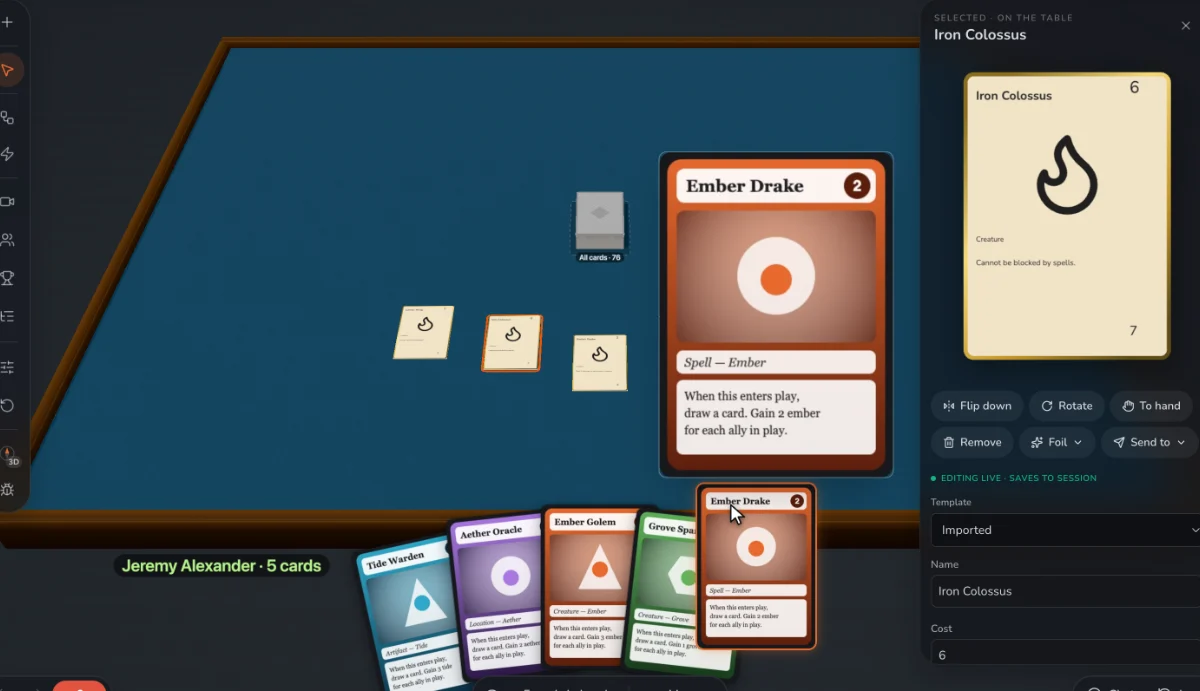
Playing with people in other places? On Prototable you can open a table and share a link, with real 3D dice and cards, and everyone joins free.
Questions
What are the ten phases of Phase 10?
Two sets of 3; a set of 3 and a run of 4; a set of 4 and a run of 4; a run of 7; a run of 8; a run of 9; two sets of 4; seven cards of one color; a set of 5 and a set of 2; a set of 5 and a set of 3.
How many points are the cards worth?
Number cards 1 to 9 are 5 points each, 10 to 12 are 10 points, a skip is 15 and a wild is 25. These are counted against you for cards left in hand.
Do you have to go out to move to the next phase?
No. You move on if you laid down your phase in the hand, even if someone else went out first.
Who wins Phase 10?
The first player to complete phase 10. If several finish in the same hand, the lowest score wins.
Prototable isn’t affiliated with Mattel. Game names belong to their owners, and this is an independent page, in our own words, for players who already own the game or want to make their own version.
More: Bingo card template · Paper dice template · Card box template · Play money template · Farkle score sheet · all game templates · card templates.