How to make a board game, in short
- Pick an idea: a theme you like or a mechanic you want to try.
- Write the turn: what a player does, how the game ends and how someone wins.
- Make a rough board by hand or from a free board game template.
- Grab pieces from things you already own.
- Play it, fix the biggest problem, and play again.
What you need for a first copy
- A board. Draw one on a large sheet of paper, or print a template. A blank board game template suits a race around a track, and a hex map suits exploring and territory.
- Pawns and tokens. Coins, buttons, dried beans, or pieces borrowed from another game.
- Dice, if your game uses them. Paper dice work fine, or use two from another box.
- Cards, if it needs them. Index cards, or our board game card template.
- A score sheet and a pencil.
Start from a mechanic or a theme, and bring in the other soon
Either works. “Pirates sharing one ship” and “you can only move what your neighbor placed” are both fine starts. By the first prototype, they should support each other, so that the rules feel like what they’re about.
Make it ugly and soon
Paper, coins and a marker, or a sketch on a shared table. Spend your first hours on whether the game works, not how it looks. The first version will be wrong, and you need to find out how.
Choose the board’s shape
The shape decides what the game is about. A track is a race: the question is how fast. A square grid suits tactics and placement. Hexes suit movement and territory, since every neighbor is the same distance. A map of connected places suits routes and control. Pick the simplest one that carries your idea.
Let the board make decisions
A good board makes interesting problems: a place everyone wants, a choke point, a long way round. A track that everyone just walks along has no decisions in it. Ask of each space: why would I go here rather than there?
Think in three acts
Early, players build. In the middle, they compete. At the end, they cash in. If the middle is flat or the leader can’t be caught, look at how actions and scores grow over a game.
Count your components
Each kind of piece costs money, setup time and something to remember. If two tokens do similar jobs, merge them. Setup time counts as part of the game’s length.
Watch the leader
Can a player who’s behind still get back in it? Can players tell who’s winning? Hidden scoring, catch-up rules and shared threats all help, each with a cost.
Test at each player count
A two-player game and a five-player game of the same design are different games. Test the extremes early, and only promise the counts that work.
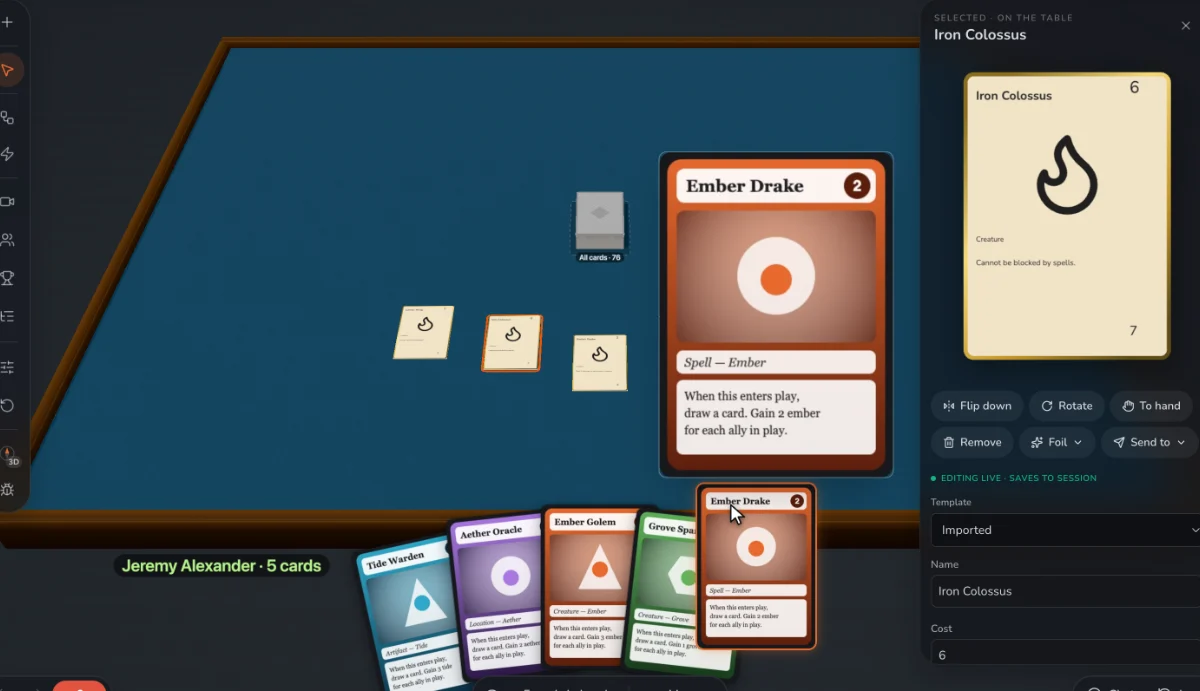
Step by step, in Prototable
- Draw the board. Sketch it, take a photo or export an image.
- Put it on a mat. Press Edit, add a Mat, upload your board and set its size, then lay a square or hex grid over it.
- Add rough pieces. Tokens, cubes, pawns, counters, dice and a bag, from Add.
- Add any cards. Import a spreadsheet, lay out a template and put the decks by the board.
- Save the setup. Save the table as a layout, so each session starts from the same place.
- Play it from a link. Players join in a browser. Change the board image or a card, and everyone sees it.
- Record and review. Press Record, and read what players said in Review.
Questions
How long does it take to design a board game?
A first prototype can take a weekend. A game ready to pitch usually takes a year or more of playtesting, often longer.
How many playtests does a board game need?
Usually dozens, including blind tests with strangers before you pitch or publish. The cheaper you can make each change, the more you can do.
Should I start with a board or with cards?
With whatever carries your central idea. Many board games start out as a few cards and some tokens, with the board coming when position starts to matter.
How do you make a board game at home?
Draw or print a board on paper, use coins or buttons as pieces, and write any cards on index cards. Glue the board to cardboard from a cereal box or a shipping box if you want it to last. Nothing has to look good until the game works.
Can I make my own board game for free?
Yes. Paper and pieces you already own are enough, and our board templates are free to print. To play it online, Prototable is free for two games, and players you invite always join free.
More guides: How to prototype a card game · How to turn a Tabletop Simulator deck into printable cards · How to playtest a board game remotely · How to import a TCG deck list to playtest it · How to make a card game · How to make a trading card game · How to balance a trading card game · How to make custom cards for Tabletop Simulator · How to publish a card game · Game card design rules · How to design a card game · What is playtesting? · How to playtest a card game online.