Set a vanilla baseline
Decide what a plain card is worth at each cost. For example, one point of cost might buy one power and one toughness, plus one extra. Then treat every ability as a price: “draws a card” costs about this much. This is a rule of thumb that testing will correct, and it makes outliers easy to see.
Look at the curve
Chart how many cards a deck has at each cost. Too many expensive cards and nothing happens on early turns. Too many cheap ones and games are decided by the opening draw.
Sort your cards, and read them side by side
A card that’s strictly better than another at the same cost is the easiest kind of problem to find, and a spreadsheet finds it in seconds.
Watch what gets played
A card that’s in every deck is too strong, or the others are too weak. A card nobody ever plays is too weak, too confusing or badly timed. What players choose tells you more than what they say.
Change one number at a time
Fix the worst outlier first, then play again, because changing one card shifts how all the others look. Small changes like one point of cost go a long way.
Balance for fun, too
A card can be fair and still miserable to play against, like one that stops an opponent from doing anything. Treat that as a problem even if it wins exactly half its games.
Let some cards be uneven
A strong card that needs setup, or a weak card that’s funny, can make a game better. Aim for many viable decks, not identical cards.
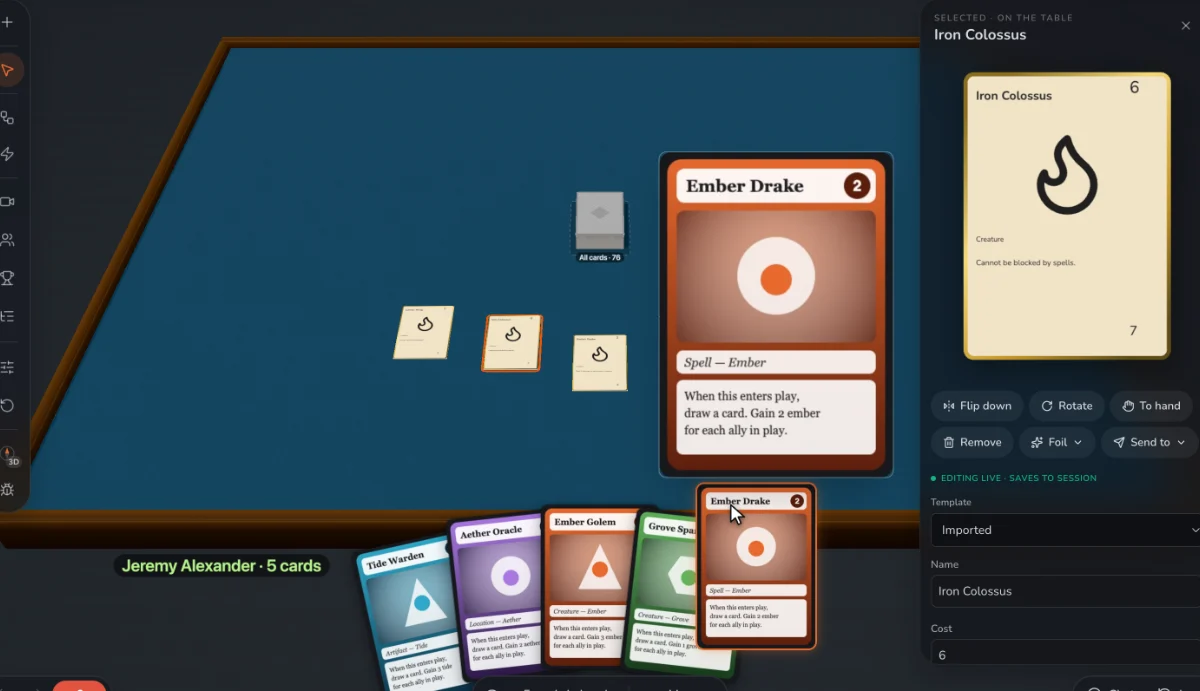
Step by step, in Prototable
- Put your cards in Data. Sort and filter by cost, type or any column of your own.
- Build opposing decks. In Decks, keep several test decks from the same card pool.
- Play with Record on. Each session is kept with its log.
- Fix it mid-game. Edit a card when it’s obviously wrong. Every copy updates at once.
- Leave notes on cards. Right-click a card and add a note, so you remember why you wanted to change it.
- Review the changes. In Review, go through each change card by card and keep or discard it.
- Go back if it got worse. Restore a recorded session’s start to replay the same position with your new numbers.
Questions
How do you know if a card is overpowered?
It’s in every deck, it wins games by itself, or players feel there’s nothing they can do about it. Check by playing it against your best answers, not just your average cards.
How many playtests does balance take?
Many, and it never fully ends. Each change shifts the rest. The cheaper a change is to make, the more of them you can try.
Can I test balance by simulation?
For simple rules, yes: tools like nanDECK include a simulator. But simulations don’t tell you what’s fun, and most games are too complex to simulate well, so people still do the most useful testing.
More guides: How to prototype a card game · How to turn a Tabletop Simulator deck into printable cards · How to playtest a board game remotely · How to import a TCG deck list to playtest it · How to make a card game · How to make a trading card game · How to make custom cards for Tabletop Simulator · How to publish a card game · Game card design rules · How to design a card game · How to make a board game · What is playtesting? · How to playtest a card game online.