Choose how players pay for things
The resource system shapes every card you’ll write. Land-style cards you play from your hand, energy that grows each turn, or resources you pick from a shared pool all make very different games. Pick one that does something existing games don’t.
Decide what wins
Reduce a life total, control the board, collect a set, score points. The win condition decides what your cards are for, and it helps to be able to say how a game ends in one line.
Keep card types few
Two or three to start: something that stays in play, something that happens once, and perhaps a resource. Each new type is a new set of rules every player has to hold in their head.
Build two decks with different plans
One aggressive and one defensive will show you more than two similar decks. About 40 to 60 cards each. Playing the same two decks ten times teaches you more than playing ten new decks once.
Keep the numbers in a spreadsheet
Sort by cost and look at the stats. A card that’s better than another at the same cost, in every way, is a mistake or a deliberate rare. A curve of costs shows whether a deck can actually do something on each early turn.
Don’t think about rarity or boosters yet
Collecting is a business model layered on a game. Make the game fun with everything open first. Rarity matters later, for complexity and for how often a card turns up.
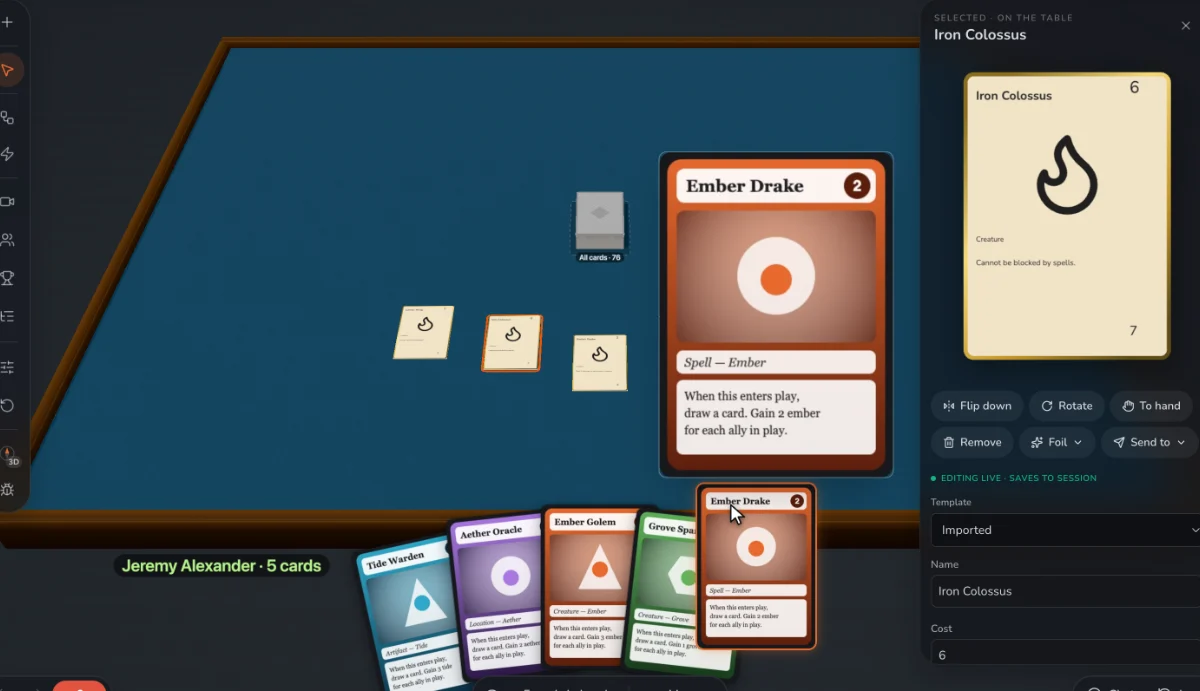
Step by step, in Prototable
- Write a page of rules. Open Rules and write the turn, how you pay, and how you win.
- Make a template per card type. In Templates, one layout for each type, with a color and back of its own.
- Write the cards. In Data, or import a spreadsheet. A Rarity or Set column of your own helps later.
- Build two decks. In Decks, make two lists with counts. A change to a card reaches both.
- Play both sides. Add a stand-in and switch seats, then invite someone from a link.
- Test against a known game. Paste a real deck list at your own private table to compare power levels. A game holding imported cards can’t be published.
- Record and review. Press Record, change cards mid-game, and go through each change in Review.
Questions
How many cards do I need to make a TCG?
Start with two decks of 40 to 60 cards. Many of those can be repeats, so perhaps 40 different cards. Growing to a full set of 100 to 300 comes much later.
Can I make a TCG by myself?
Yes, up to the point of a strong prototype. Art, manufacturing and finding players are the expensive parts, and can wait.
Should I copy the rules of a game I like?
Learn from them, and do something different. A clone has to beat the original, with its years of cards and its players. Your one new idea is the reason to play yours.
More guides: How to prototype a card game · How to turn a Tabletop Simulator deck into printable cards · How to playtest a board game remotely · How to import a TCG deck list to playtest it · How to make a card game · How to balance a trading card game · How to make custom cards for Tabletop Simulator · How to publish a card game · Game card design rules · How to design a card game · How to make a board game · What is playtesting? · How to playtest a card game online.