Video game studios use the word too, often for early access or bug testing. This guide is about tabletop games, where a playtest asks a bigger question: is this game any fun, and do people understand it? The basics hold for a card game or a board game.
The four kinds of playtest
- Solo. You play every seat. It catches rules that contradict each other and turns that take too long. It can’t tell you whether the game is fun.
- With you teaching. Friends or other designers play while you explain. It shows you what confuses people and where the game drags.
- Blind. Strangers play from your rulebook while you stay quiet. It tests the rules themselves, because you won’t be in the box when someone buys it.
- Remote. Players join online. It gets you far more sessions, as nobody has to travel. See how to playtest a card game online and how to playtest a board game remotely.
Decide what this test is for
Pick one question before you start, such as “is the last round tense?” or “can people learn this in five minutes?” A session that tries to test everything tends to teach you very little.
Tell players what you need
Say that the game is unfinished, that you’re testing the game and not them, and that nothing they say will hurt your feelings. Ask them to say what they’re thinking as they play. Otherwise you get polite silence.
Watch more than you talk
Don’t explain, defend or fix anything mid-game unless the game has stopped. Note where people hesitate, reread a rule, reach for their phone or lean in. What they do tells you more than what they say afterwards.
Ask better questions afterwards
Skip “did you like it?”, as people are kind. Try: when were you bored? Which moment do you remember? What did you want to do that you couldn’t? If you could change one thing, what would it be? Who did you think was winning, and why?
Treat complaints as symptoms
Players are good at noticing that something feels wrong and worse at knowing the fix. If someone says “this card needs a lower cost”, write down that it felt too weak to play, then work out the cause yourself.
Change one thing, then test again
Pick the biggest problem and change only that. If you change ten things, you won’t know which one helped. Keep a note of each version, so you can go back and compare.
Know when to stop
You’re nearly there when new groups stop finding new problems, strangers can learn the game from the rulebook, and people ask to play again. Asking to play again is the strongest sign you’ll get.
Step by step, in Prototable
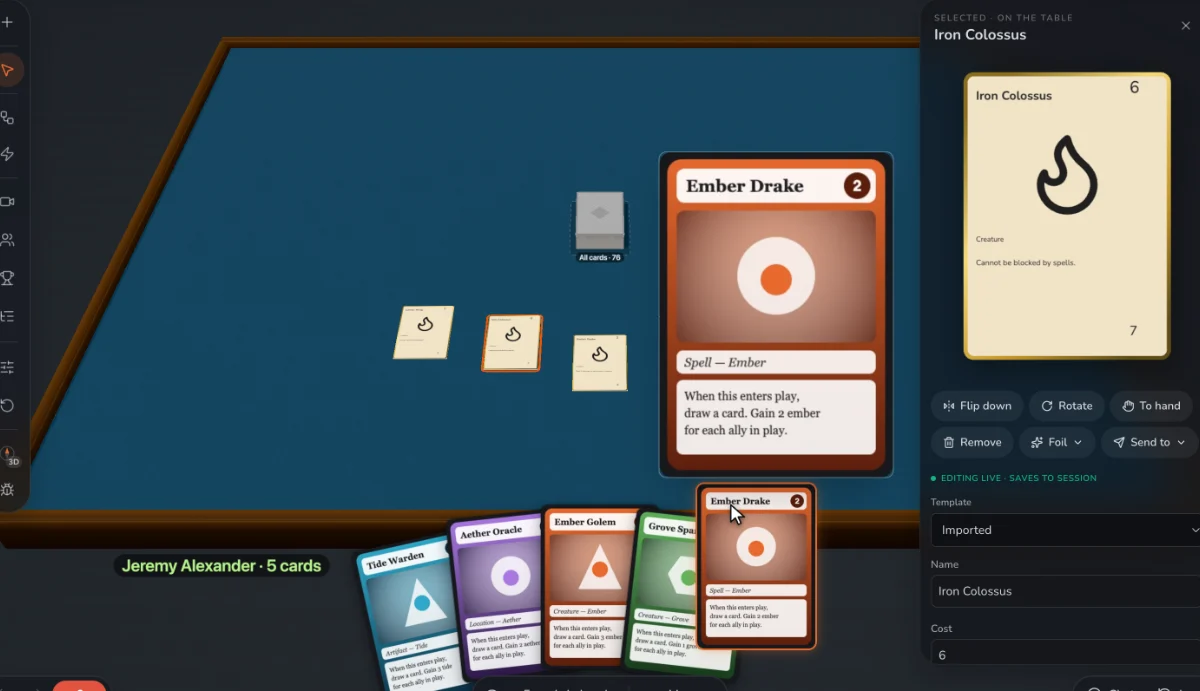
- Put your game on a table. Add your cards and pieces, or import what you have.
- Test alone. Add stand-ins to play every seat yourself.
- Invite playtesters. Copy the table’s link. Players join free, in their browser, with no account.
- Record the session. Press Record to keep the session’s start and end, and notes from players.
- Change cards as you play. Edit a card mid-game and everyone sees it at once, so you can try a fix straight away.
- Read it back. Open Review to see what changed and what players said about each card.
Questions
What does playtesting mean?
Playing a game before it’s finished, to find out what works and what doesn’t, so you can change it. The people who do it are called playtesters.
What is the difference between playtesting and beta testing?
Playtesting asks whether the game is fun and understandable, and it starts while the game is still rough. Beta testing usually comes near the end and looks for bugs and problems in something nearly finished.
How many playtests does a game need?
There’s no set number. Most designers run dozens, and many run far more for a bigger game. Stop counting and look for the signs instead: new groups stop finding new problems, and strangers can learn it from the rulebook.
How do you find playtesters?
Start with friends, then trade sessions with other designers, who give the most useful feedback. Local game stores, design groups and online communities such as r/tabletopgamedesign are good places to find people. Strangers matter most, since they have no reason to be kind.
Can you playtest a game on your own?
Partly. Playing every seat yourself finds broken rules and slow turns, so it’s worth doing first. Only other people can tell you whether it’s fun.
More guides: How to prototype a card game · How to turn a Tabletop Simulator deck into printable cards · How to playtest a board game remotely · How to import a TCG deck list to playtest it · How to make a card game · How to make a trading card game · How to balance a trading card game · How to make custom cards for Tabletop Simulator · How to publish a card game · Game card design rules · How to design a card game · How to make a board game · How to playtest a card game online.